
Written by Lisa Kensler.
Some professional development experiences add a few new ideas to your toolbox. Others quietly change the way you see the world. Last summer’s Discover Nature’s Genius for Social Innovation immersion at Montana’s beautiful B Bar Ranch, co-facilitated by Dayna Baumeister and Toby Herzlich, did the latter for me. Although biomimicry has influenced my scholarship for nearly two decades, what I found wasn’t a new way of thinking as much as a deeper, more rigorous way of exploring questions that have long shaped my work. Surrounded by Montana’s wide-open landscapes, I found myself returning to a deceptively simple question: What if nature were our oldest and wisest leadership mentor? That question has stayed with me ever since. It reshaped the way I think about leadership, strengthened my commitment to sustainability, and became the inspiration for a complete redesign of EDLD 7210: Multiprofessional Leadership.
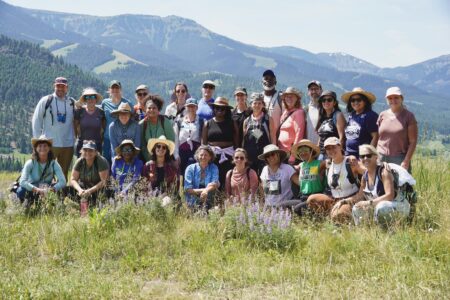
A group of professionals at BBar Ranch in Montana experiencing Discover Nature’s Genius for Social Innovation immersive workshop.
Auburn University’s commitment to sustainability calls us to “meet human needs now and in the future in a fair, just, and equitable way while protecting and maintaining healthy ecosystems in perpetuity.” Biomimicry contributes another set of questions and practical tools that can strengthen this work by encouraging us to learn directly from organisms and ecosystems that have been navigating complexity for billions of years. Coined and popularized by biologist Janine Benyus, biomimicry invites us to learn from nature’s 3.8 billion years of successful adaptation. In addition to inspiring us to protect the natural world, biomimicry invites us to learn from nature. It encourages us to see the living world as model, measure, and mentor, inspiring innovations that are well adapted to their environments and supportive of life. Many people associate biomimicry with remarkable technological advances—Velcro inspired by burrs, quieter wind turbine blades inspired by humpback whale flippers, or high-speed trains shaped by the beak of the kingfisher, among so many more. Yet biomimicry reaches far beyond engineering and product design. As Dayna Baumeister and her colleagues at the Biomimicry Institute have helped demonstrate, it also offers practical ways of thinking about systems, relationships, and the conditions that enable life to flourish. For me, this realization was more than theoretical. The experience reinforced for me that the questions I’ve long explored in schools and organizations are, at their heart, questions about living systems. 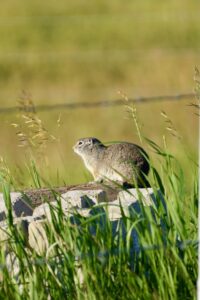
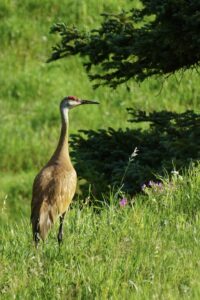
A couple of the animals you can learn from at BBar Ranch.
For many years, my scholarship has centered on questions of leadership, trust, and human flourishing. The immersion didn’t change those questions; it invited me to explore them through the lens of biology, ecology, and living systems. In other words, I found myself looking to nature not only for inspiration, but for wisdom. These insights became the foundation for EDLD 7210: Multiprofessional Leadership, a course guided by a simple question: How might nature’s genius inform the practice of leadership? One emerging area that especially excites me is The Nature of Trust, a collaboration between the Biomimicry Institute and Biomimicry for Social Innovation that explores how trust functions in living systems and what those patterns might teach us about human communities and organizations. Having spent years researching trust in educational settings, I find this intersection especially compelling and look forward to participating in the Nature of Trust Co-Lab.
Whether your interests lie in the sciences, design, education, engineering, business, healthcare, public service, or community development, biomimicry offers a refreshing invitation to look at the natural world with new eyes. It doesn’t ask us to admire nature as outsiders; it invites us to become better students of ourselves as integral members of the living world. If you are curious to learn more, I encourage you to explore resources such as AskNature, the Biomimicry Institute, Biomimicry for Social Innovation, and Janine Benyus’s classic book Biomimicry: Innovation Inspired by Nature. I’d also be delighted to share more about EDLD 7210: Multiprofessional Leadership and our MEd and PhD in Administration and Supervision of Curriculum with anyone interested in continuing the conversation.
The next time you walk across Auburn’s campus or pause beneath a tree, consider that every organism around you represents millions of years of successful adaptation. What might nature’s genius have to teach us—not only about sustainability, but also about leadership, collaboration, resilience, and creating communities where life can flourish?
Written by Lisa Kensler, Leischuck Distinguished Professor of Educational Foundations, Leadership, and Technology.