By Michael Brunson*
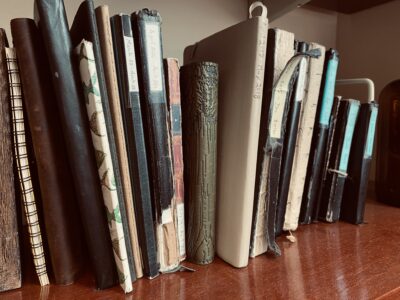
Photo by Michael Brunson
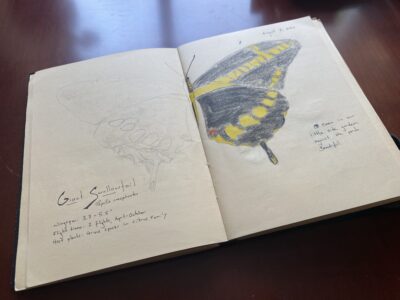
One of my tried-and-true tools in my teaching toolkit is a field, or nature, journal. Whether I am teaching a class on natural history, environmental interpretation, or outdoor recreation, having students keep a field journal throughout the semester has not only improved engagement and helped link classroom learning to the real world, but they have also served as a way to personalize the learning experience, providing an outlet for students to focus and share what they connect with and find meaningful in the field.
Nothing revolutionary, naturalists from Charles Darwin to Rachel Carson used field journals to aid in the collecting and cataloguing of observations and reflections on the natural world. Their, among others, detailed notes, sketches, and drawings have contributed greatly to the scientific community. And as much as they can serve as a teaching and learning tool, over the years I have found that they can serve another benefit – by encouraging us to slow down, observe what’s around us, and help nurture a greater appreciation for the natural world.
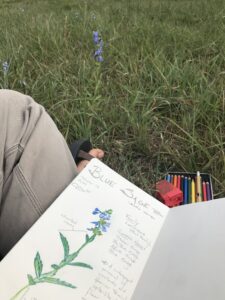
Photo by Michael Brunson
And before any anxiety over sketching or drawing begins, don’t worry. You don’t have to be a Picasso to reap the benefits of nature journaling. Below, I offer a step-by-step guide to starting your very own nature journaling journey, and all it requires is a notebook or even some paper, a pen or pencil (or colored pencils, watercolors, etc. if you are the artistic type!), and getting outside.
1. Go outside.
This does not need to be an expedition. One of the first steps in taking time for purposeful nature observations is recognizing that this can happen anywhere. In your backyard. On campus in between classes. On a sidewalk bench, waiting for friends. You do not have to plan an extensive trip, but rather take advantage of any free time outdoors, wherever you are.
2. Look around
Even when we do take the time to get outside, whether that’s on a trail or on a campus green, we often get distracted by other things. What are our weekend plans? Worries about classes or jobs. Our phones, something which I encourage you to put away and put on silent during this time. Simply take a breath, and start looking around you.
3. Look again
No, seriously, look again. There is a distinguishable gap between looking and seeing. When we don’t take the time to truly see, we often miss those things that are right in front of us, such as a hawk or owl perched in the tree that is so well camouflaged, it’s hard to separate from the tree itself. Or the monarch butterfly chrysalis nestled under the leaf of a milkweed plant.
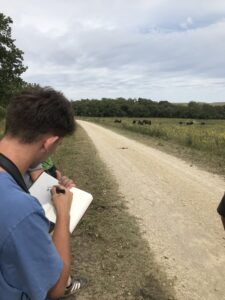
Photo by Michael Brunson
4. Put “pen to paper.”
Whatever utensil you have on hand, just start writing. Or sketching. Or doodling. Anything. You do not have to be an illustrator or poet, only purposeful. What do you see? What can you identify? What are you curious about? These musings could be anything from simply keeping a list of wildlife you spot, plants that draw your interest, or even the cloud patterns in the sky. Just take the time to observe and write down those observations.
5. Repeat
Keep up the practice! Anytime you happen to be outside, start making that time for purposeful observations. Have a break between classes? Sit outside and make some observations. Go on a hike in Chewacla State Park with friends? Bring your journal and make some observations. Morning coffee on your porch? Make some observations. Repetition not only strengthens your observation (and artistic!) skills but also helps create a repository of information that can be meaningful to look back on.
These days, it often feels like we are just go, go, go all the time. Get to class. Get to work. Get to the summit. Get back to the car. Get “somewhere.” Even in those moments of go, taking the time to slow down and look at what’s around you can help not only create connections between you and the natural world, but also help ground ourselves.
Nature journaling can help boost creativity, deepen ecological understanding and awareness, and help generate a sense of place. Marcel Proust, the French novelist, said, “The real voyage of discovery consists not of seeing new landscapes but in having new eyes.” This is what purposeful observation through nature journaling can help us do; see the world around us with new eyes.
Michael Brunson is a professor of Practice, Parks and Recreation Management.