
Written by Michael Brunson.
With a Ranger’s hat and shovel and a pair of dungarees
You will find him in the forest always sniffin’ at the breeze,
People stop and pay attention when he tells ‘em to beware,
‘Cause everybody knows that he’s the Fire Preventin’ Bear.
This song may not have made it into your top 20 Spotify playlist recently, but I would wager most of you reading this know who these lyrics refer to. Written in 1952 by Steve Nelson and Jack Rollins, the song Smokey the Bear not only helped continue the popularization of this American icon, but it also launched a long-standing debate over how to say his name properly. But more on this later…
These days, Smokey Bear is synonymous with our national forests as well as the natural environment in general. Smokey Bear may be the official wildlife prevention symbol of the United State Forest Service, but we often place him in any natural resource context and conservation-related conversations. And while his iconic look and quotes attributed to wildlife prevention and the wise use of our treasured national forestlands are often comically portrayed, the underlying purpose of this ursine symbol does play an extremely important role.
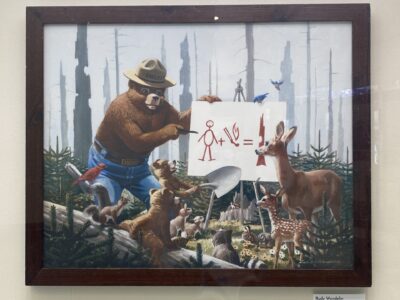
A featured painting in the Smokey exhibit at the Hartsfield–Jackson Atlanta International Airport
Now, I could simply share facts like how wildfires are becoming more frequent and burning with greater intensity. Not only that, but the nationwide “fire season” is getting longer as well, increasing the potential for catastrophic wildfires. I could talk about how nearly 85% of wildland fires in the US are caused by humans.
I suppose I could talk about how, in considering our Leave No Trace principle of Minimizing Campfire Impacts, we can continue to protect and enjoy our natural landscapes when properly managing our campfires. And yes, sometimes this means not having a campfire at all. However, there are alternatives to a traditional campfire that still allow us to cook our meals or enjoy the soft glow of a shared light source.
But instead, I’m going to share some fun Smokey Bear facts that will make you a legend should the topic come up at your next trivia night.
Smokey Fact #1
The idea of Smokey Bear was essentially a marketing campaign, born from a wartime ideology in 1944 to help protect our forests and natural resources. The idea was that, by being negligent with our natural resources, we would be helping the Axis Powers during WWII.
Smokey Fact #2
The actual bear who would end up personifying Smokey came later, in 1950. An injured bear cub was rescued during a wildfire in New Mexico and the crew named the cub “Smokey.” Moving him to the National Zoo in Washington, D.C. ushered him into the limelight and helped immortalize the cub as the Smokey Bear we know now.
Smokey Fact #3
Smokey Bear has his own zip code. Awarded in 1964, only Smokey and the U.S. President are the only individuals to have their own personalized zip code. You can still write to him today at:
Smokey Bear
Washington, D.C. 20252
Smokey Fact #4
There is an official “Smokey Bear Act.” Passed in 1952 by Congress, it removed Smokey from the public domain and placed him under the control of the US Department of Agriculture. To this day, all royalties and fees collected from licensed Smokey products are used for wildfire prevention education.
Smokey Fact #5
Over the years, Smokey has had many “voices.” Many celebrities and athletes have lent their voices and talents to the Smokey Bear campaign, including Bing Crosby, Roy Rogers, Betty White, Dolly Parton, Ray Charles, and Joe Montana.
Smokey Bear Fact #6
Despite the song, his official name is NOT Smokey the Bear. While the song certainly helped with Smokey’s fame, “the” was added only to maintain the rhythm of the song. Now you can count yourself as a die-hard Smokey fan knowing that he was, and continues to be, Smokey Bear.
Smokey Fact #7
Lastly, and appropriate for the season, Smokey first appeared in the Macy’s Thanksgiving Day parade in 1966 and continues to make appearances in the parade.
So, there you have it, a crash course in Smokey Bear history. Wow your friends and impress at that Forest Service interview if you ever go work for the agency. But Smokey lore aside, we always need to be mindful of the potential impacts fire can have on our natural environments. Especially in the backcountry, properly planning ahead and preparing can ensure that regulations are being followed, the environment is being protected, and you can still have a positive outdoor experience. Oh, and it can also help with minimizing any negative impacts when cooking that deep-fried turkey…
Happy Thanksgiving!
Written by Michael Brunson, Professor of Practice and Leave No Trace Level 2 Instructor, Parks and Recreation Management, College of Forestry, Wildlife & Environment.