
By Emily Moore*
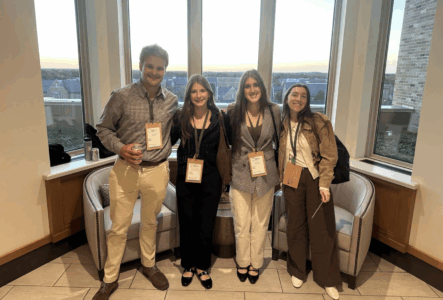
On October 20-22, 2025, the staff of the Auburn University Office of Sustainability attended the second annual National Sustainability Society (NSS) Conference held at the University of Notre Dame. Our crew of intrepid travelers included Program Manager Amy Strickland, Outreach and Communications Manager Jen Morse, and their student intern team: Cole Bedics, Lilly Dawson, Chloe Hoefling, Emily Moore (that’s me!), Yarianna Rangel, and Sarah Reilein. Braving the chilly high of 60°F in South Bend, Indiana, we attended keynote addresses, ate inventive vegetarian fare, learned about groundbreaking sustainability research, networked with sustainability practitioners from around the world, and even got to visit Warren Dunes State Park in Michigan to learn about the unique Great Lakes ecosystem.
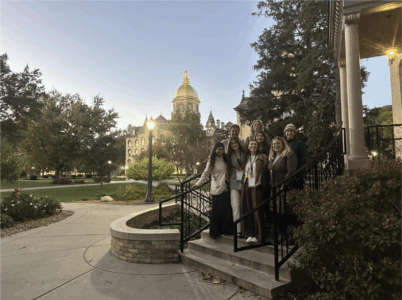
NSS 2025 was held at the University of Notre Dame’s beautiful campus.
On the first day of the conference, we had the pleasure of attending the opening keynote speech given by paleoclimatologist and former dean of the University of Washington’s College of the Environment Dr. Lisa Graumlich. Our AU Office of Sustainability Social Media Specialist Chloe Hoefling took a lot away from this powerful speech:
“At the National Sustainability Society Conference, one message really stuck with me. We can’t create a sustainable world if we’re burned out ourselves. The keynote speaker, Dr. Lisa Graumlich, talked about how we have lost touch with our natural feedback loops, which are our body’s way of telling us to rest, reset, and recover. It made me realize that sustainability isn’t some external goal but an internal practice as well. The life we live reflects the world we create.” – Chloe Hoefling
Program Coordinator Yarianna Rangel also found the keynote speech enlightening:
“Her message about the role of empathy and collaboration in driving sustainability deeply resonated with me.”- Yarianna Rangel
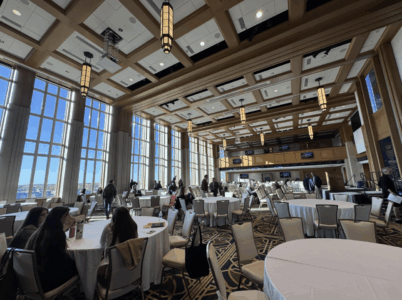
The opening keynote was held in a gorgeous ballroom at Notre Dame’s student center.
My favorite aspect of Dr. Graumlich’s presentation was her call to action. She wrapped up her talk by putting up a presentation slide that invited attendees to “go deeper”, “find your edge”, “create spaces”, “practice both/and”, “refuse the pace”, “remember you are not alone”, and, most poignantly, “keep showing up”. Working towards a more sustainable and environmentally healthy world can often feel like an uphill battle. Because of this often discouraging struggle, it is vitally important to remember that there is value in continuing to engage in sustainability work each day. This inspiring message was the perfect way to begin our conference.
For the next two days, we attended talks centered around the conference’s central 2025 theme: Transformative Change for a Just and Sustainable Future. These sessions covered topics across the sustainability sector, from industry and supply chains to education and research to government and policy. There truly was a topic for everyone!
Our team heads to a session!
Some of our team found the industry-focused talks to be the most valuable, such as Marketing Specialist Lilly Dawson:
“Attending the National Sustainability Conference was a great opportunity to hear from corporations, universities, and researchers about current action and advancements in the world of sustainability. Through attending panels and speaker presentations each day, I gained a lot of insight about the different ways individuals are handling environmental change in various professional fields.
One of the sessions that I found most interesting was a panel of 3 individuals representing companies who are implementing sustainable food production into their processes. The companies represented were from all across the world, as the panel showcased a rum company from Belize, maple syrup producer from Michigan, and a global food and beverage supplier. Each panelist shared how climate change is impacting their harvesting regions, elements of their business’ supply chain, and overall production. However, they also shared the innovative ways their industries are combating the negative effects of climate change, and how they plan to further improve the system that they’re involved in. The information I gained from this panel informed me that there are people actively working to improve food production and that there is hope for a more sustainable future in our agriculture systems.” – Lilly Dawson
As an Apparel Merchandising major passionate about sustainable fashion, Yarianna was excited to attend a session focused on sustainability in the textile industry:
“One of my favorite sessions was ‘Just and circular future in the materials industries’, focused on sustainable materials, where the speakers discussed the importance of raising awareness about fabric overproduction and the role fashion brands play in promoting more conscious consumption.” – Yarianna Rangel
There were also many sessions focused on how sustainability can be promoted through academia. These talks were of particular interest to Jen Morse:
“Workforce development and producing students that support the needs of industry were common topics in my conference sessions. A particularly dynamic panel included a mix of industry partners and academics who shared their experiences collaborating with the other group. The session revealed silos not only exist on campuses between colleges, but also exist between industry and academics, in both research and teaching.” – Jen Morse
Through this session, Jen was able to build a list of possible improvements that could be made in education to help prepare students for sustainability work in industries:
- “Academics need to better develop the workforce to meet the needs of industry. 50% of graduates employed in industry actually do work in sustainability, whether or not it is in their job title. There are many diverse pathways to doing sustainability work.
- Industry is looking for students with a foundation of knowledge in understanding sustainability science, goals, and certifications. Suggestions were made that a course on earth system sciences and policy should be in the university core curriculum.
- Students need skills in: communicating with all people, explaining efficiencies and strategies for reducing waste and usage of energy and water, and reporting on GHG emissions. In addition, students need problem solving abilities, interpersonal skills, and thinking strategically, future-focused, and in systems.
- Effective collaborations included joint research projects, community-based projects, and internship programs. Together, everyone needs to make the business case for sustainability.” – Jen Morse
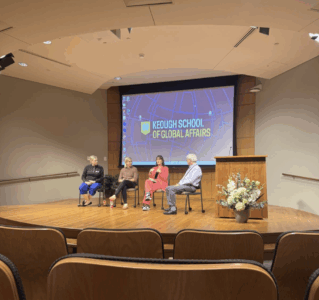
A view from one of the many sessions we attended!
Other staff members, myself included, attended sessions with a broader range of topics. For example, I had the opportunity to see many interesting research presentations given by graduate students and professors. Topics included passive climate control strategies in architecture, indigenous cultures’ adaptations to climate change, and the effect of environmental health on the mental health of farmers, just to name a few. I had a lovely and deeply informative time learning about the myriad ways that sustainability is being studied across disciplines. Program Coordinator Sarah Reilein also enjoyed the variety of topics explored at NSS:
“Attending the National Sustainability Society Annual Conference opened my eyes to the limitless applications of sustainability. I attended presentations on circular economy, sustainable supply chains, electric vehicles, sustainability in organizational operations, experiential learning, sustainable food production, and a whole lot more. This experience brought me a better understanding of how sustainability can be applied to any discipline.
One insight that really stuck with me from one of the presentations is the idea that you don’t need to search for job titles or descriptions that specifically say “sustainability” because you can apply sustainable thinking and practices to any job. This conference has left me inspired to pursue sustainability in whatever career I end up in and feel confident that I can make a meaningful impact.” – Sarah Reilein
Engagement Coordinator Cole Bedics learned a lot from the speakers that originated from different sectors:
“I found at the NSS that there are a lot of very smart people who are very intensely working on ways to make our world more sustainable. From professors, PHDs, practitioners, and professionals, this conference provided the opportunity to hear from a wide range of voices.
An important lesson that I learned during a talk about human health and sustainability was the consequences of action. The consequence of implementing sustainable action has a real effect on the number of lives saved. For example, 11.1 million lives per year could be saved through a universal switch to a more sustainable diet. 3.9 million lives per year could be saved by turning away from car travel.
Scientists have had difficulty in the past determining how much of our current weather is due to climate change. Now with the development of detection and attribution techniques, we can now definitively say how much of a disaster is climate change’s fault. For example, the heat wave in the Pacific Northwest last summer claimed 500 lives. Scientists can now show with data that this heat wave would have been climatically impossible if it was not for climate change. This change of the narrative towards a focus on human health could show itself to be more effective in the future of litigation over climate change.” – Cole Bedics
Of the various sessions that Amy Strickland attended, one talk exploring a unique and deeply human sustainability practice stuck with her:
“I appreciated the wide range of topics discussed at NSS and valued the opportunity to learn from both researchers and practitioners. One session that particularly stood out to me was on somatic governance. To start, the session was rooted in applied research, which resonated with both my nerdy and practical sides. The presenters did an excellent job of demonstrating the various ways we can address complex problems by integrating our whole selves into the solution-generation process. Society often overemphasizes the mental aspects of problem-solving, leading us to leave our emotional selves “at the door.” This tendency creates a disconnect, both internally and externally, and overlooks the valuable wisdom our emotions can contribute to the situation. Inviting our whole selves into the process can be challenging, but establishing structured methods to incorporate our embodied knowledge makes the experience more manageable and productive. The presenters provided a range of strategies to achieve this, including generating a play envisioning a possible climate future for Buffalo, creating popsicle recipes with reclaimed wastewater in Phoenix, using random objects to build memories and envision futures in urban design, and organizing embroidery circles with Mexican women to improve greenspace development. These practices showcased how rich, imaginative, innovative, and generative the process can be by bringing people together through embodied, emotion-filled experiences and highlighted the promise they hold for creating a brighter tomorrow.” – Amy Strickland
NSS provided reusable wooden name badges to reduce plastic waste!
In closing, the 2025 National Sustainability Society Conference was an inspiring and educational professional development opportunity that we are so grateful to have attended.
“Going to the NSS was inspiring to me,” says Cole, “It was a chance to see on a global scale all the things that people are doing to make the world a more sustainable place.”
“Overall”, Lilly elaborates, “this conference served as a reminder to me that people have not forgotten that sustainable change is necessary, and that many people are putting in the work to implement change. I left feeling very hopeful of reaching sustainable goals through consistent and collective action.”
“Beyond the sessions, it was also wonderful to share this experience with my colleagues from the Office of Sustainability,” explains Yarianna. “We learned together, exchanged ideas, and got to know each other even better. Overall, the conference reminded me that achieving a just and sustainable future is within our reach when we take transformative action, both individually and collectively.”
As for me, I am so excited to apply what I learned at Notre Dame to my work with the Office of Sustainability here at Auburn. War eagle!

Office of Sustainability staff members exploring Warren Dunes State Park!
Emily Moore serves as the Outreach Coordinator for our office.