
By Jamie Johnson*
Last year I was given the opportunity to complete the Karen Pryor Academy Comprehensive Dog Trainer Program, and to sum it up, it has completely changed my outlook. I was interested in taking this course for several reasons and I am happy that I did. For starters, I love animal behavior and this course goes in-depth in that aspect. I also wanted to gain more confidence when leading and instructing fourth-year veterinary students when it comes to animal handling and behavior.
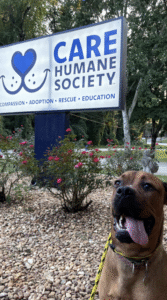
A canine at the shelter benefitting from positive reinforcement by being asked to sit and loose leash walk with food rewards.
The course itself, being run under the principles that Karen Pryor stood for, which were force-free and positive-reinforcement training, was thorough and made it easy to learn and navigate. Karen Pryor was a pioneer in clicker training and animal behavior and built a legacy that so many in the animal world look up to. Even if you aren’t exactly in the field of animal work, you have probably unknowingly trained and worked under the beliefs for which she advocated.
A few important takeaways from this program that I have been able to use daily include TagTeach, positive reinforcement, and marking. TagTeach is when you take longer instructions and cut them up into easier to perform tasks. So instead of saying, “Go grab the patient from his kennel and start working on sedating him, placing a catheter, intubating him, and getting him prepped for surgery,” we break it down into easy to perform tasks, “Grab the patient,” “Sedate the patient,” “Move the patient to the wet table,” etc. I have found that with this new strategy of teaching, it is less stressful for the students. They don’t become as overwhelmed and nervous to forget something. This saves me a lot of time and repetition. This not only goes for the students, but also for the patients. We can use this for the patients when we want them to walk on a leash by saying, “Let’s go!” and when we want them to get into a kennel by saying short phrases like “Go kennel!” and leading the leash in that direction. This can also be applied anywhere else in your life for any user, as behavior is everywhere everyday. While this specific course is geared towards animal professionals, it can also be applied to human behavior.
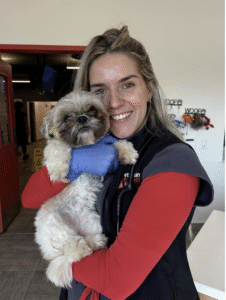
A low stress veterinary visit that was met with lots of cuddles.

Felines at the shelter benefitting from positive reinforcement by learning that when someone comes into their area, they are met with pets or treats.
Positive reinforcement and marking are also two very important aspects in teaching. These methods make the one being taught more eager to continue learning, versus constantly being told what they are doing wrong and not wanting to perform at all. Being aware of what not to do is extremely important in veterinary medicine, but reinforcing what students are doing correctly is easier for students to retain and makes a teaching environment more inviting. While you cannot clicker train a human, or at least you shouldn’t, you can provide positive reinforcement and marking with positive feedback when completing a task or when a student is showing growth. In the Shelter Medicine Department this can be congratulating a student for several reasons, such as them successfully placing an IV catheter, recognizing that they were able to navigate a fearful patient, and giving them kudos for coming out of the surgery suite smiling knowing that they just completed something they were terrified of just one hour ago. For our patients, this looks like saying, “Good boy,” “Yes,” and providing treats. The first two probably aren’t ideal for teaching humans, but I don’t think someone would be too upset if you gave them a piece of chocolate after they did something correctly.
My goal is to teach students that they can apply this everywhere, and when they go into practice they can work with doctors, technicians/assistants, and clients and have the confidence on what to do while navigating difficult patients and cases. I also want them to remember that behavior applies to all species, not just the ones that can fit into an exam room.
Jamie John is the recipient of the Sustainability Professional Development Sponsorship Award.