
By Christopher Keirstead*
In early November of 2025 I participated in a group tour of the Upper Mobile-Tensaw River Delta led by environmental journalist, photographer, and documentary filmmaker Ben Raines. Raines is also the author of two books that grow out of his deep knowledge of the history and ecology of the delta region: Saving America’s Amazon: The Threat to Our Nation’s Most Biodiverse River System (University of Georgia Press, 2020) and The Last Slave Ship: The True Story of How the Clotilda Was Found, Her Descendents, and an Extraordinary Reckoning (Simon & Schuster, 2022).
Saving America’s Amazon first came to my attention through my teaching and research interests in travel writing and eco-tourism. Raines’s “America’s Amazon Adventures” offers a rare opportunity for the public to explore this region in all of its biodiversity in a sustainable and ecologically sensitive way. Indeed, I felt like I was living out his book on the ground (and on the water), encountering many of the same species of trees, plants, and animals described in Saving America’s Amazon.
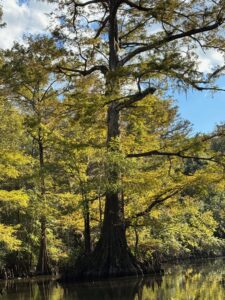
One of the many cypress trees of the Upper Mobile-Tensaw River Delta
The small and intimate nature of the tour also contributes to the sense of getting know the delta up close: taking only six guests at a time, Raines’s boat could easily float into the many hidden inlets and coves we passed. During one of these side excursions, for instance, we were able float directly underneath a native Alabama tree orchid in bloom.
The upper delta tour is one of two of extended tours Raines offers, the other focusing on the lower delta region and taking place in the spring months. The fall tour also includes two short hikes. The first of these is on Mound Island, where Native Americans of the Mississippian period had made a large settlement dotted with their distinctive high mounds or middens. Equally fascinating was the still clearly visible trench that had once been a canal running through the center of the settlement. Raines drew our attention to specific plants and flowers growing on the island and their different medicinal and ceremonial uses, helping us to better appreciate the wide plant knowledge of the area’s original inhabitants.
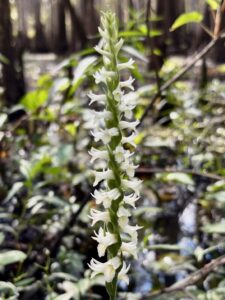
‘Lady’s Tress’ orchid in bloom.
Raines’s own knowledge of plant and animal species, including which were native and which invasive, seemed to know no bounds. When I asked how he had learned all this, he mentioned that his work as a journalist with the Mobile Register brought him into contact with a host of scientists and other experts working in the region—including many with ties to Auburn. He still has a network work of various experts—on fungi, for instance—whom he consults with when he sees something new.
The second hike took us to see a giant cypress tree estimated to be over 500 years old. Hip boots are must for this particular excursion, as the last part of the hike takes you through mud and water that can become waist deep after a good rain. To be in the presence of this natural wonder is breath-taking, but this was also the part of the tour where the threat to this wilderness became most palpable. Two hundred years ago, “this place would have been a forest of giant cypress,” he reminded us. The only reason this particular tree survived the intense logging of the area was that it was hollow in the center (though still alive) and thought not worth the effort to cut it down.

A surviving giant cypress tree
The tour offered several other unique and somewhat hidden insights into the profound impact of logging in the delta and how far back it extended. On our hike to the giant cypress, Raines pointed out several of the trenches that had been dug in the past that allowed logs to be floated down the river and shipped off. By the 1850s, he noted, there were already four steam-powered saw mills in the region. Later in the tour he stopped us at another logging site where a steam-powered winch from about 1900 had been abandoned, with cypress knees now growing up through the wooden remains of the barge that once held it. It was a poignant reminder of how relentlessly the area had been logged, up through the late twentieth century, when helicopters were used to fly out what had been cut down.
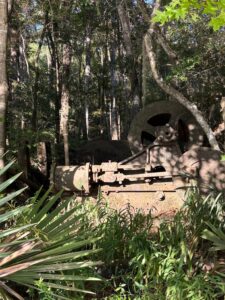
An abandoned steam-powered winch among the cypress
The biggest environmental threat to the region now, as described in Saving America’s Amazon, may be over-development along the edges of the various waterways that feed the delta. “The first step” in preserving it, Raines writes in his book, “is to revel in the existence of this wilderness, richer by almost every measure than any other place in the nation, yet scarcely known even to the people who live closest to it” (16). Those that do know it well were the same people who took the first steps to protect it—private citizens who bought portions of the land and laid the groundwork for Alabama’s Forever Wild Foundation, which continues efforts to protect wilderness in the state.
Having now experienced the upper delta up close myself, if only for one day, I walked away with a much deeper and profound sense of what was at stake in the effort to preserve and protect “America’s Amazon.” It was a reminder to me as well, as an Auburn faculty member, of the importance of sharing that understanding with students and all those who value, in Raines’s words, “this incredibly rich and rare place we call Alabama” (12).
*Christopher Keirstead serves as an Associate Professor of English at Auburn University and is the recipient of the Sustainability Professional Development Sponsorship Award.