
By Tatum Osmon*
Well-being is not only an individual pursuit, but an interdependent process in nature and in human communities. Many know the common idea of “company culture” in workplaces, classrooms, or even research settings. This general idea can be observed and understood through an ecological lens, where every member influences the overall outcome and health of the whole. As someone who is majoring in marine biology and fisheries, the parallels between ecological systems in nature and interpersonal relationships are almost impossible to ignore. Just as organisms within an ecosystem rely on each other for survival, people depend on meaningful, stable relationships for resilience and growth as well. When I look at well-being through this ecological lens, it becomes clear that relationships are not just helpful, but they are the foundation of personal and community health.
Nature has innate relationships that offer a compelling metaphor for the fundamental need for relationships in humans. During my summer classes at Dauphin Island Sea Lab, the balance of life in nature was on full display. There was one day when we had a guest professor come and speak about their research. Dr. Robert Hataway, a conservation and population genetics researcher at Samford University, talked about a seemingly minute, meaningless spider that lives in dunes along the Gulf Coast. In his research, he looked at the population genetics of the Santa Rosa Wolf Spider and found that populations were becoming genetically different. This was particularly interesting, knowing that their habitat is linear, meaning they only live in the stretches of the dunes with no other suitable ecosystem. His findings found that anthropogenic impacts and increasingly harsh weather patterns were making populations diverge from each other. The health of their populations affects other dune and coastal species, which create cascading effects throughout the environment. In the same way, this process happens in humans. The sustainability compass, nature, society, economy, and well-being, illustrate how these dimensions rely on each other to create a balanced, healthy community. When we can support others, the stable networks between people, and on a broader scale, communities, mirror the innate structure of ecosystems, even as small as dunes in the Gulf. By thinking this way, I began to see that our well-being is partly dependent on each other, and it’s not just an individual effort.
From my experience in a research lab, here at Auburn, I have seen my workplace function as this living ecosystem. Just like specific species in an ecosystem, each member of the lab fulfills a niche that contributes to the group’s stability. From our primary investigator, who guides and sparks projects, to the technicians who execute the day-to-day work, each person shapes the success of the lab in a different way. Even the informal dynamics, from celebrating defenses to talking about classes, are reflections of this interactive community. Viewing the lab in ecological terms shows that the motives behind every small task or conversation lead to a web of bonds that shape collective flourishing.
Along with the broader application within my research lab, there was also a specific moment where I saw this concept come to life. Early on in my experience as a student technician, our full-time technician began to transition into a Master’s student for the following semester. The shift in roles, from being the newbie and getting my feet under me, to taking on all the technician responsibilities rather quickly, taught me the need for adaptability. Rather than the transition causing instability and chaos, it encouraged collaboration, mentorship, and trust. I began asking more questions and became more involved with every active project happening. The graduate students began to request my help, even playfully fighting over who got my help each day I was working. I did not know it yet, but this was the beginning of my integration into a healthy ecosystem, and it did so without a fault. This experience showed me that giving and receiving support is a vital tool for creating thriving communities.
My relationships in the lab have not only shaped a significant part of my academic career here at Auburn, but it has also become a part of my sense of belonging. As well, the process of building them showed me that my individual well-being is incredibly important not only for my own personal success, but also that it is inseparable from the community I am a part of. These individual relationships, within the web of our lab, have strengthened my confidence, capabilities, and knowledge. My resilience was not built from only my own problems, but by being supported and supporting others through theirs. Our connections, whether they be classmates, friends, or coworkers, are truly an ever-growing ecosystem. After looking at my own community, this view of “people ecology” made me realize that sustainability begins with how we connect to each other. When we connect with others, we strengthen not only our individual well-being, but the communities we are a part of, small or big. In this way, interdependence, exemplified in nature, is a model for a sustainable society.
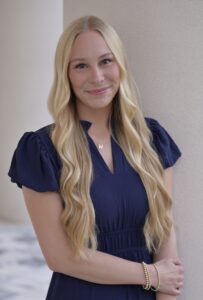
Tatum Osmon is a senior majoring in Marine Biology and Fisheries
Tatum Osmon is the 2025 Sustainability Essay Contest Winner*