SDG 12: RESPONSIBLE CONSUMPTION & PRODUCTION

Ensuring sustainable consumption & production patterns is the purpose of Sustainable Development Goal 12 (SDG 12). This goal strives to decrease waste, use & reuse resources efficiently, & adopt zero-waste practices.

Actions, stories, & resources related to SDG 17: Partnerships for the Goals are shared in our latest Auburn University and the United Nations Sustainable Development Goals report. They are shared below to illustrate Auburn’s impact. For an overview highlighting our commitment to the Sustainable Development Goals (SDGs), please visit aub.ie/sdg.

Sustainable Development Goals Logo

SDG 12: RESPONSIBLE CONSUMPTION AND PRODUCTION

Future economic and social progress depend on sustainable production and consumption patterns. Responsible consumption and production address issues related to food, fuel, over-extraction of resources, social and ethical impacts of product manufacturing, and all other issues involving waste and excessive resource use.

Auburn University is highly engaged with Goal 12, especially through teaching activities. There were no fewer than 90 courses offered from 2019-20121 relating to responsible consumption and production. Auburn University’s sustainability-oriented minors have the highest correlation with SDG 12 at 3 minors. As the world navigates a future of waste elimination, efficient systems, and resource depletion, Auburn University has the potential to be a leader in the charge to navigate these realities sustainably.

View our most recent Auburn University and the United Nations Sustainable Development Goals report  for an overview of Auburn’s contributions to all the SDGs.

Actions at Auburn

The Natural Resources Management degree equips students with the knowledge necessary to conserve, maintain, and manage systems of natural resources. Housed in the College of Forestry, Wildlife and Environment, this interdisciplinary degree aims to solve diverse and contemporary issues in resource consumption. Based on the relationship between humans and their environment, the Natural Resources Management Degree uses the sustainability compass as a framework to provide humans with the resources needed for the future. Natural Resources Management requires a minor from one of these related areas of study: Nature-Based Recreation, Watershed Sciences, Urban Environmental Science, Natural Resource Ecology, International Business, or Sustainability.

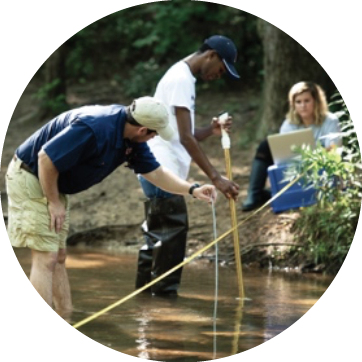
People doing watershed monitoring

SCMN 4620, offered through the Harbert College of Business, addresses how a company must strategically incorporate environmental, social, and economic dimensions of sustainability into its supply chain decision-making. Pressure from customers, policymakers and non-governmental organizations compels companies to address the environmental footprint of their operations and the social impact they have on local communities. Specific topics include ethical sourcing, risk management, transparency, innovation, resource scarcity, waste reduction, carbon emissions, and human rights issues. SCMN 4620 exposes students to the UN SDGs in addition to principles of supply chain management.

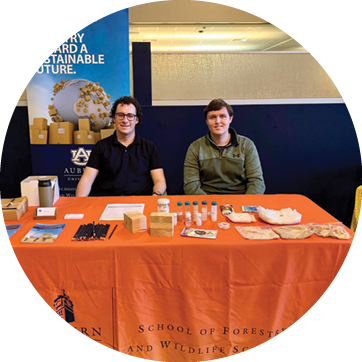
Member of the Sustainable Biomaterials and Packaging Society tabling.

The Sustainable Biomaterials and Packaging Society is a student organization with the goal of educating fellow students and faculty on the Sustainable Biomaterials and Packaging Major, as well as discussing professional advancement in relation to the interests of its members. The club focuses on professional outcomes and practical use of utilizing forest biomaterial sustainably. The society provides students a space to explore intersections of biological, ecological, environmental, social, economic, and ethical considerations in sustainable biomaterials and packaging markets in order to provide focus for their future graduate programs, employment, and experiences.

Environmental concerns and evolving technologies are moving companies toward the use of sustainable forest biomaterial for everything from packaging, cosmetics, and automobiles to appliances, pharmaceuticals, and commercial construction. This degree program, offered through the College of Forestry and Wildlife Sciences, is aimed at providing students with knowledge, expertise, and hands-on experience to prepare them for careers in packaging manufacturing product development and marketing, biomaterials research, supply chain management, and distribution and logistics.

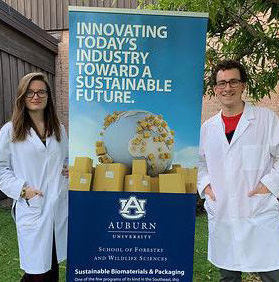
Sustainable Biomaterial students sdg Photo courtesy of Hannah Lester

As an Associate Professor in the College of Architecture, Design and Construction, Professor Jerrod Windham focuses on sustainable design strategies for the production of goods and services. Prof. Windham studies the elimination of waste and works to increase efficiencies in supply chains, to improve social and environmental sustainability in communities, benefiting businesses and consumers alike. Through his innovations in digital fabrication, Dr. Windham works to evolve systems of entrepreneurship, assistive technology, and environmental sustainability. Prof. Windham also leads the annual Designing Green initiative, consisting of guest lecturers and a sustainable design competition.

Design sketch
Scientists in RFID lab SDG 12 Photo courtesy of Radio Frequency Identification Lab

The Radio Frequency Identification (RFID) Lab, housed in the College of Business, works with industry partners to increase effectiveness of RFID technologies to improve serialized data sharing within the retail industry. The RFID Lab is a research institute focusing on the business case and technical implementation of RFID and other emerging technologies in retail, aviation, supply chain management, and manufacturing. RFID Lab has had success in multiple public-private partnerships, including Amazon.com. RFID technology promotes responsible consumption and production by reducing counterfeit items within the retail industry, which promotes ethical consumption, and improving the accuracy of on-hand inventory at retail stores, which will reduce the instances of excess product and unnecessary shipping.

People & Stories

Our Future, Our Time: Future Council Film Screening

| Events, Sustainable Development Goal 12, Sustainable Development Goal 17, Sustainable Development Goal 9 | No Comments
By Sarah Reilein* On Thursday, February 26, 2026, the Office of Sustainability held its next screening in our spring semester film series: Future Council. This 2024 documentary follows Damon Gameau as he takes eight kids on a road trip across Europe to seek solutions to our greatest ecological challenges.   Throughout the film, the children confront a symbolic character named “Groth.” “Groth” represents humanity’s constant pursuit of more and its negative impact on the planet.  Spinning off the word…

Why Studying Abroad in London Changed Me

| Guest Blog Posts, Sustainable Development Goal 12, Sustainable Development Goal 4 | No Comments
By Olivia Lambert * When I went to London, I thought I was going to study fashion. I thought I would take note of trends, colors, silhouettes, and what people were wearing compared to the United States. I did notice those things. I noticed beige everywhere. I noticed designer bags on every…

Cook for Yourself, Care for the Planet 

| Guest Blog Posts, Sustainable Development Goal 12, Sustainable Development Goal 3 | No Comments
By Sarah Reilein* One of my favorite ways to unwind has always been cooking and experimenting in the kitchen. Trying to multitask my chopping, stirring, and boiling water gives me something actually fun to “stress” about that is low risk, but high reward when my dish turns out delicious.   If you are also someone who enjoys cooking,…

STITCHES, STORIES, AND SECOND CHANCES – A Review of Mending Night

| Guest Blog Posts, Sustainable Development Goal 12 | No Comments
By Cole Bedics* We all like to buy new clothes, but the ones we already own can be the most important to us. They may be stretched, discolored, and even stained by the journey that you have taken them on. The sense of nostalgia and meaning of putting on the shirt your parents wore when they were young, or a shirt you have worn through thick and thin, is a…

Planning Purposeful Events

| Guest Blog Posts, Sustainable Development Goal 12 | No Comments
By Cole Bedics* Sometimes it feels bad to splurge on throwing a party. Hats you’d only wear once, party favors in plastic bags, the massive bag of paper plates and plastic cups, along with all the other waste that you will most definitely create.   In no way do I want to shame you, the reader, for having a…

Explore the SDGs & AU